Digital EthnographyCybersecurity StudiesCivic TechnologyResearch Documentation
Tools | Google Sheets, Looker Studio, Figma
Language | HTML, CSS, JavaScript
I. CONCEPT
WHAT
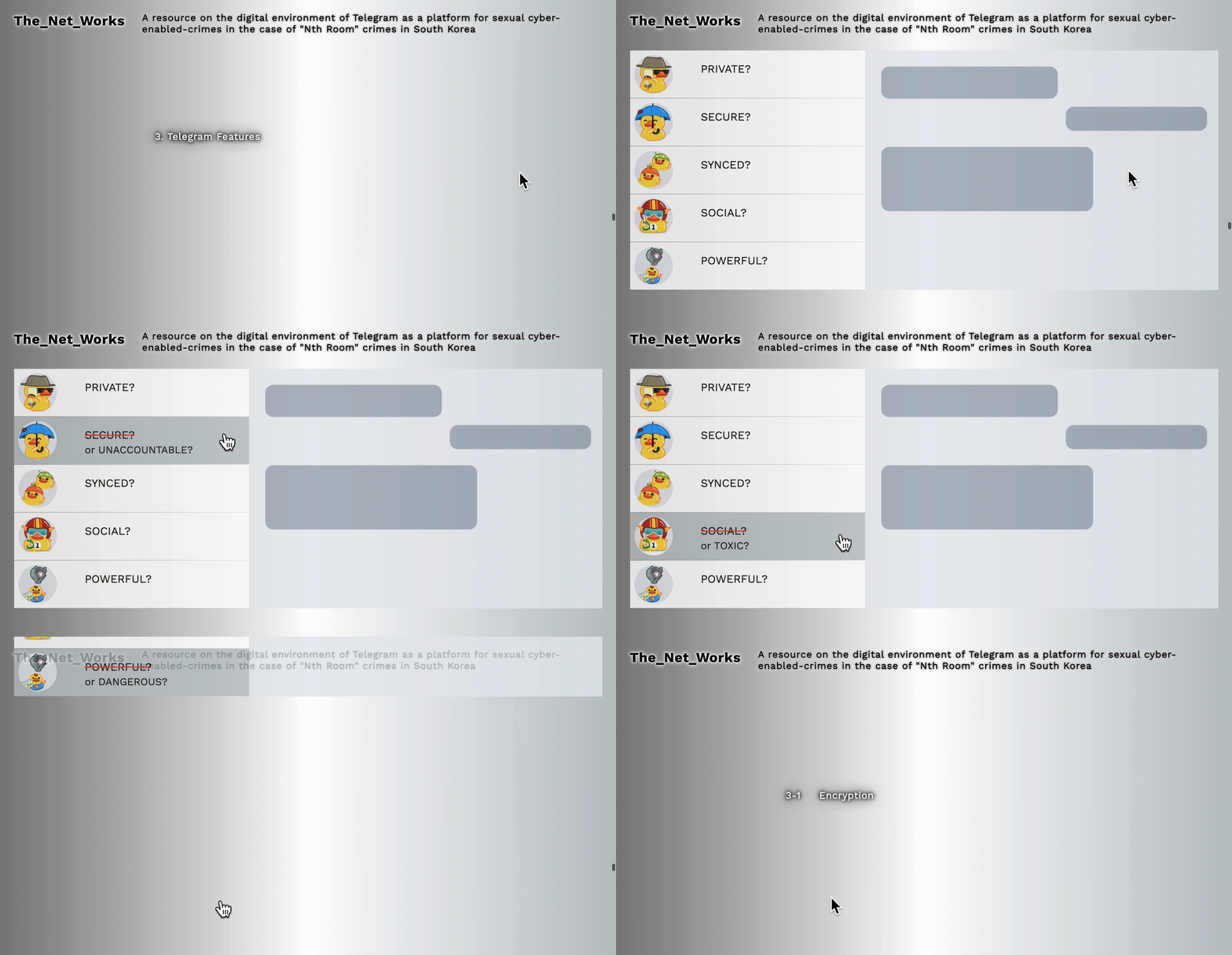
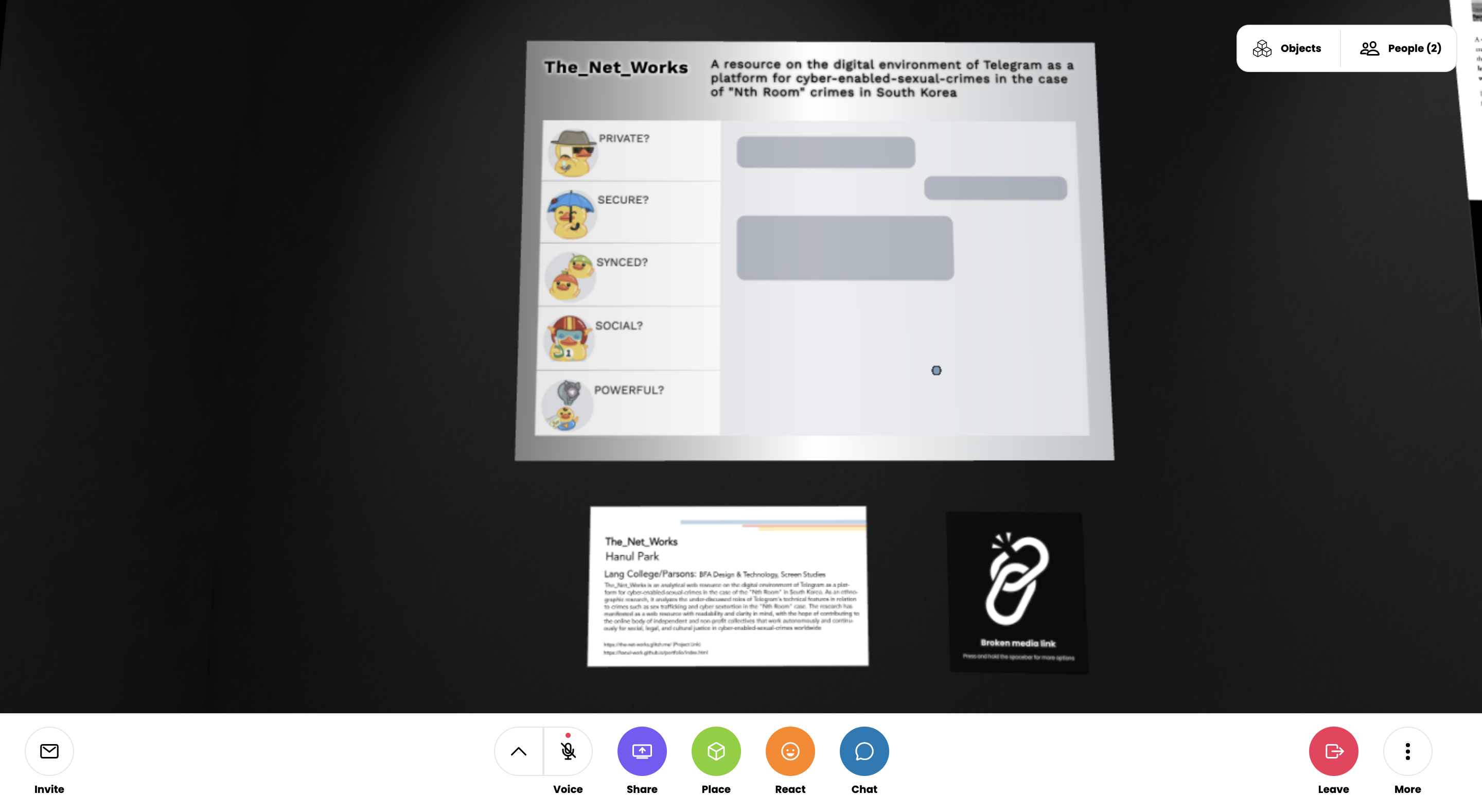
This research project delves into the cyber environment of the messaging platform
Telegram, specifically analyzing its role in the infamous "Nth Room" case, a
harrowing example of sextortion and human trafficking. The project sheds light on
the often-overlooked aspects of Telegram's technical features that may have
facilitated these crimes. Employing an ethnographic approach, the research is
visualized as an interactive web map resource. This contribution aims to serve as
a valuable tool for online communities and collectives working towards global
justice in the fight against digital sex crimes.
WHY
This project investigates the role of Telegram, a secure and widely used messaging
platform, in facilitating the horrific "Nth Room" case. This case involved a
series of interconnected digital sex crimes, including blackmail, sextortion, and
the distribution of exploitative content. While the crimes have received
significant attention, the technical aspects of Telegram that may have enabled
them remain largely unexamined.
This research addresses this gap by employing an ethnographic approach to analyze Telegram's
cyber environment. By examining the "Nth Room" case through this lens, the project aims
to illuminate how specific features of the platform may have contributed to the crimes'
scope, duration, and complexity. The resulting web map resource, "The Net Works," serves
as a critical exploration of this connection, offering valuable insights for online
safety advocates and policymakers working to combat digital sex crimes.
HOW
This project employs an ethnographic approach to investigate the Telegram
environment in the context of the "Nth Room" case. Ethnography involves immersing
oneself in a particular social setting to understand its culture and practices. In
this case, the research analyzes user behavior, platform functionalities, and the
broader online discourse surrounding the case.
By examining how Telegram's features (e.g., encryption, anonymity) potentially interacted
with the abusive culture within the platform, the project illuminates the factors that
may have contributed to the crimes' severity and scale. This analysis is visualized
through an interactive web-based map, "The Net Works," which illustrates these interconnections
and serves as a tool for online safety advocates and policymakers.
The findings contribute to a nuanced understanding of the complex relationship between
technology and social harm. It challenges simplistic narratives of "democratic technology"
by exposing how seemingly neutral tools can be repurposed for harm. Ultimately, this
research sparks critical conversations about privacy, anonymity, and the ethical responsibilities
of technology companies in creating safer online spaces.
II. PRODUCT
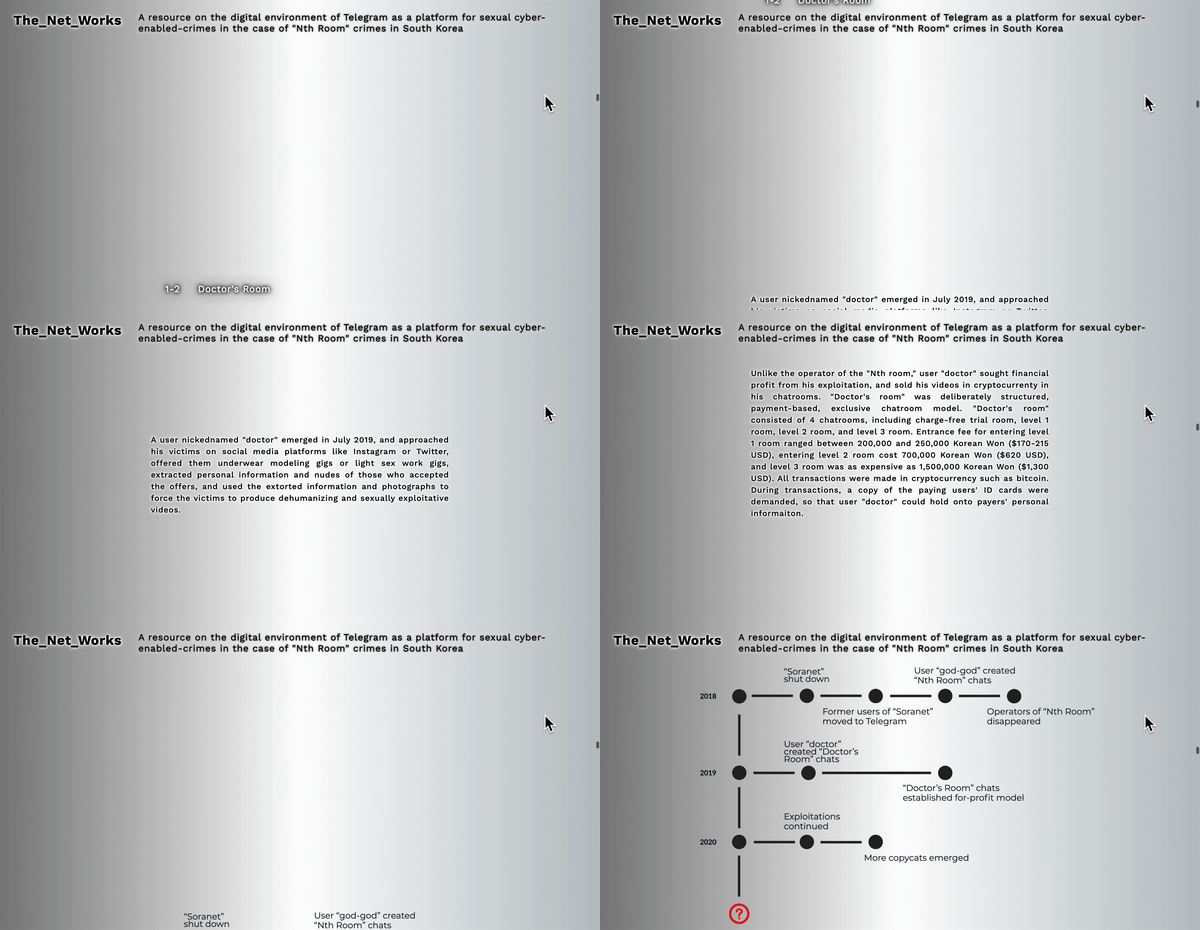
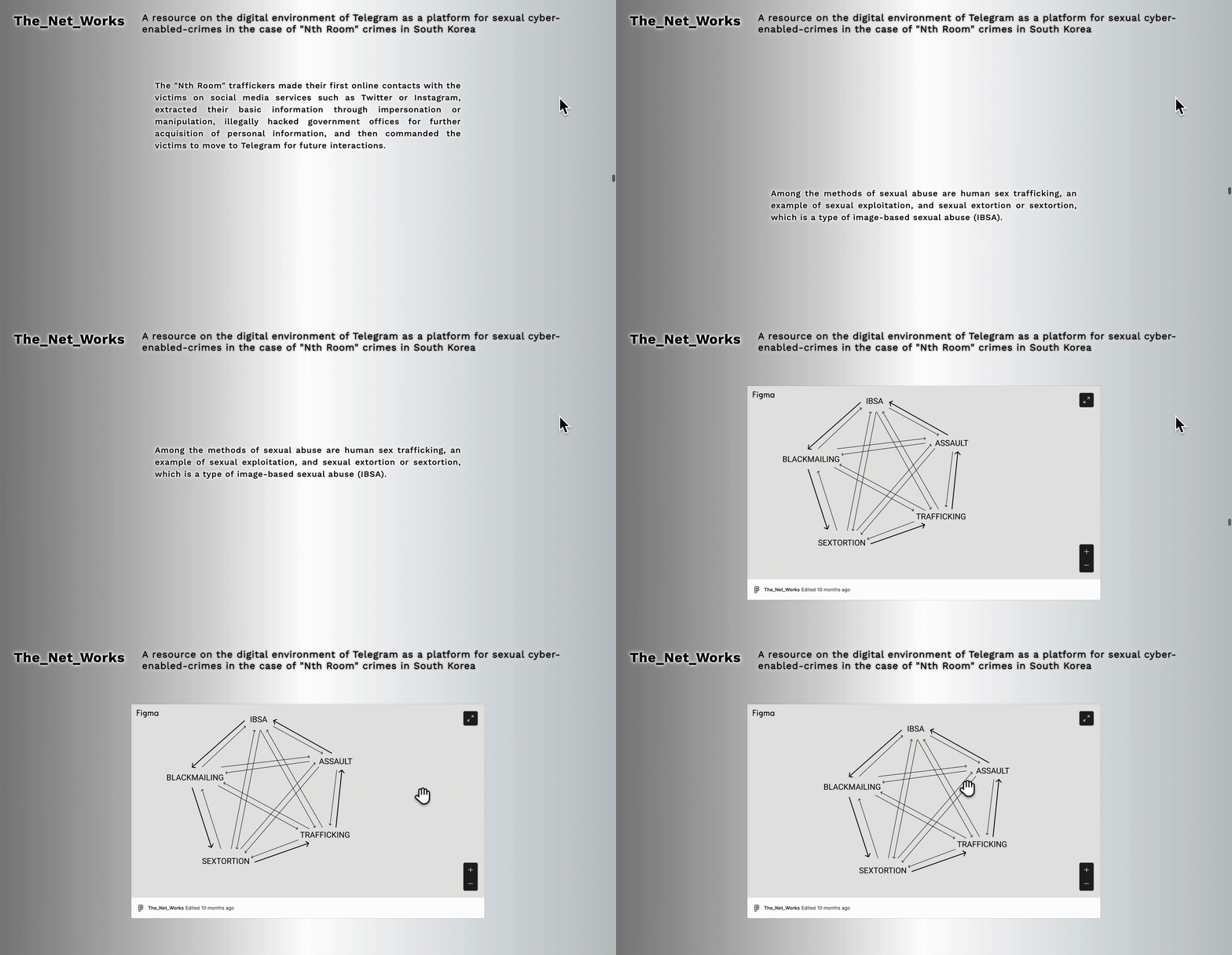
DOCUMENTATION
III. PUBLISHING
EXHIBITION
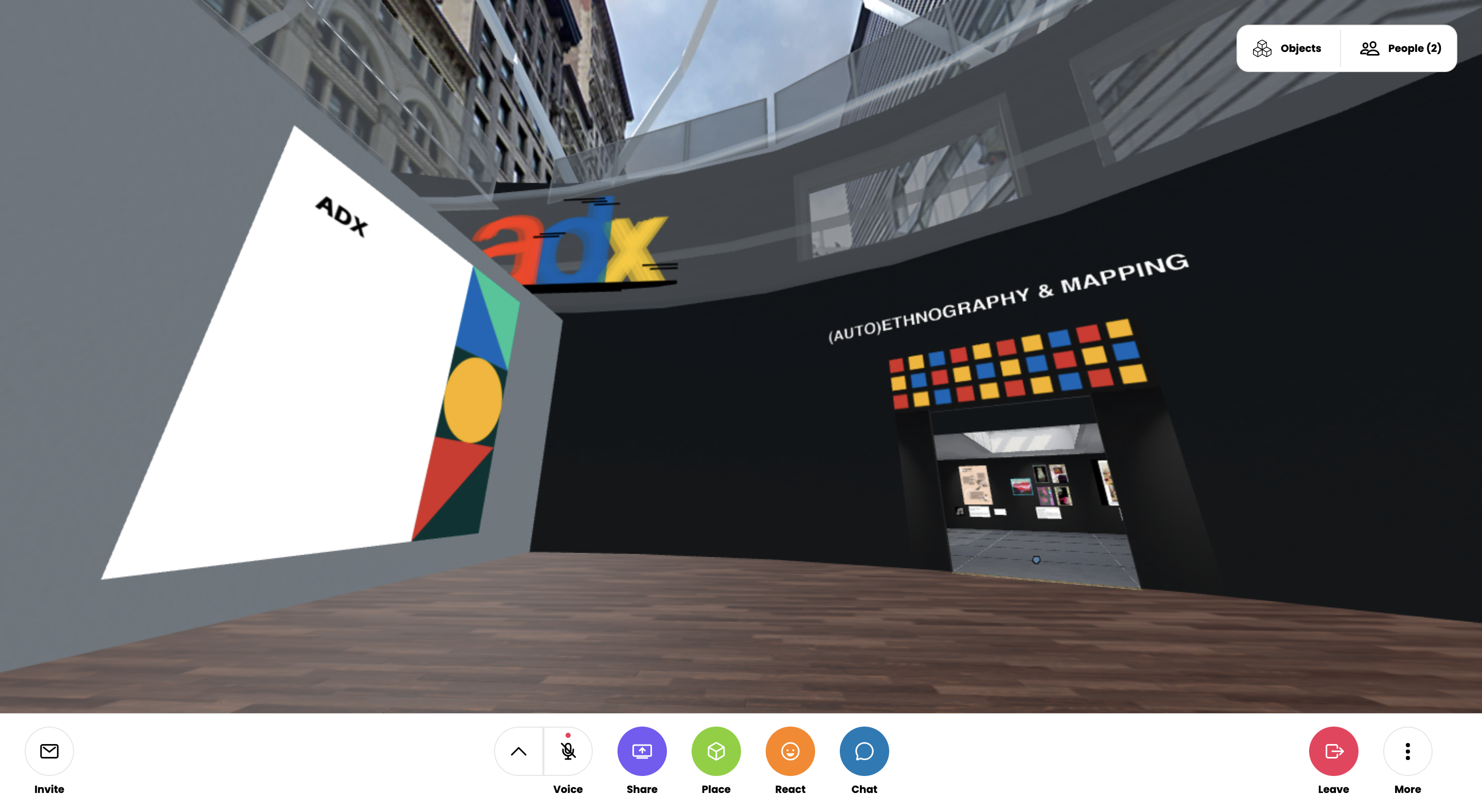
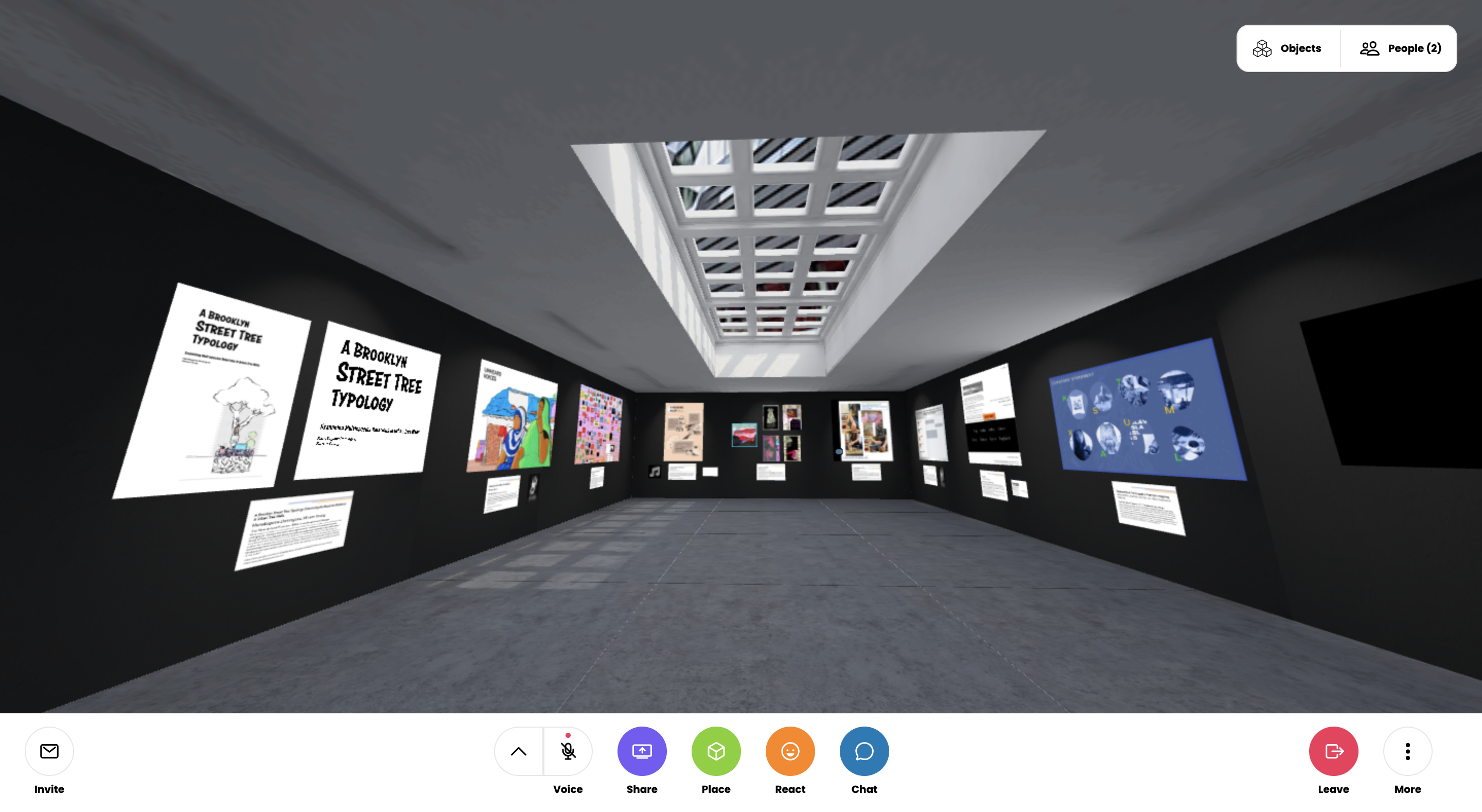
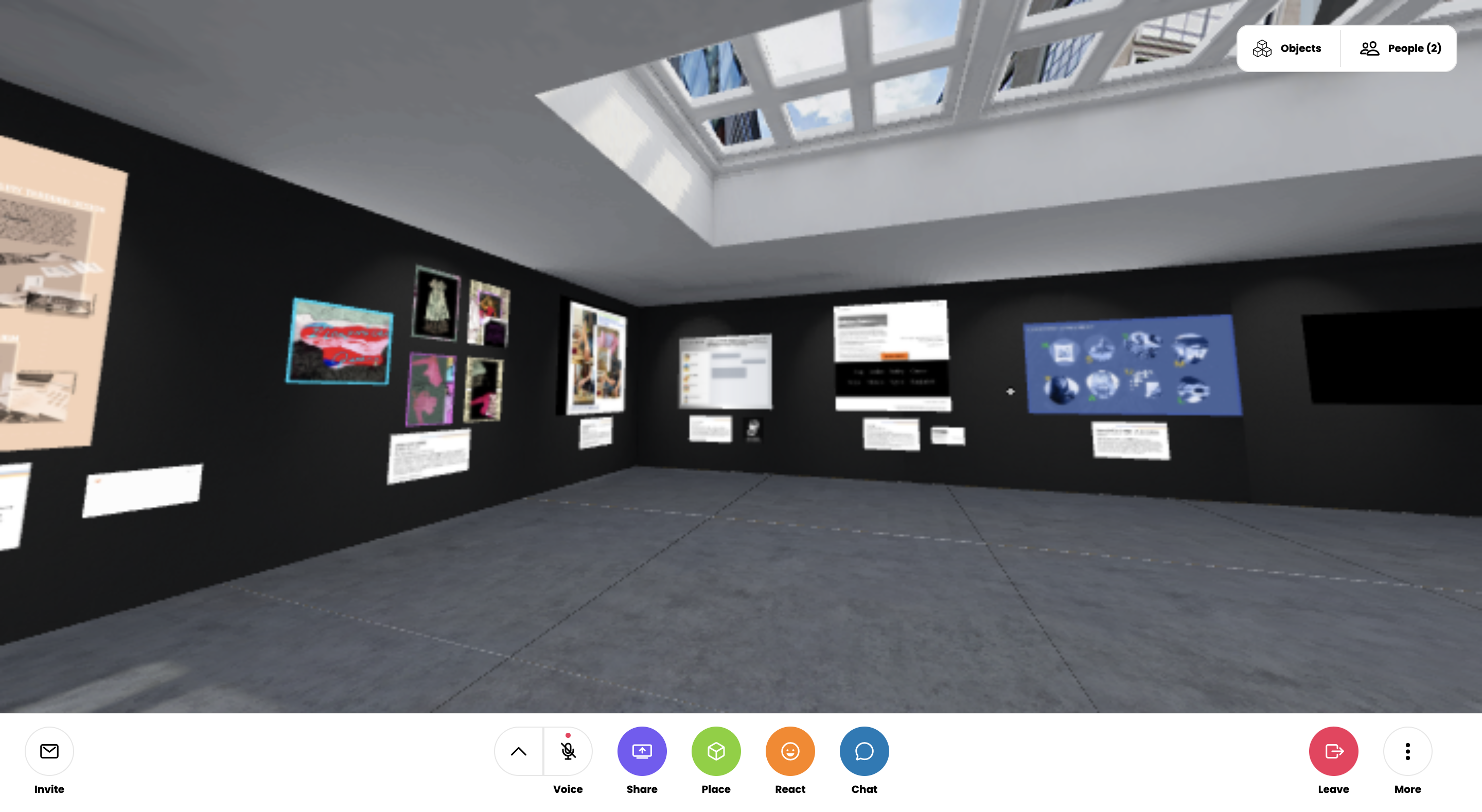
Anthropology & Design Exhibition, The New School (2021)
“ADX invites students from varied disciplinary backgrounds to explore and
experiment with anthropological and design research methods that open up new
epistemological and creative possibilities, and illuminate our lived experiences
and imaginations. The exhibition consists of a virtual reality showcase and a
series of virtual moderated panels with artists and presenters.”
National Undergraduate Research Conference on Science, Technology, Medicine
& Society, Vassar College (2021)
“The STMS Conference is an opportunity for undergraduates from across divisions
to present their research on myriad topics related to the intersections of
science, technology, medicine, and society.”
Kim, Hyejin. “Current Status of Response to Digital Child Sexual Slavery and
Comparative Analysis of Overseas Crime Prediction System Using Artificial
Intelligence.” Journal of Digital Convergence 18.7 (2020): 357–368.
This article, authored by the CEO of the Global Digital Sexual Crime Policy
Research Institute, offers a critical analysis of the "Nth Room" case. The author
delves into the criminal methods employed, highlighting how the perpetrators
exploited Telegram's secure communication features and darkcoin exchange systems.
The article emphasizes the devastating mental and psychological impact on the
victims, prompting a necessary discussion about the role of technology in
facilitating new forms of sexual exploitation.
Several key findings resonate with this project. First, the article underscores cyber
sextortion as the initial step in a multi-layered exploitation process. Second, it raises
the important issue of "possession" in the context of image-based sexual abuse, where
streaming distribution is becoming more prevalent. Third, the article highlights the
responsibility of digital platforms to prevent the spread of exploitative content. In
the "Nth Room" case, Telegram's refusal to cooperate with the investigation due to privacy
concerns is a critical point.
The research also identifies challenges in combating these crimes, such as the limitations
of tracing cryptocurrency transactions across foreign exchanges and the ease with which
evidence can be deleted on platforms like Telegram. These insights are valuable as this
project explores the connections between criminal methodologies and the technological
features that enable them.
Charles, Angela T. “The Abuse of Teenagers by Online Predators Facilitated Through
the Internet and Social Media.” MS Thesis, Utica College, 2017.
This article provides a valuable framework for analyzing cyber sexual abuse,
particularly relevant to the "Nth Room" case. The author effectively introduces
key concepts and terminology related to cybercrime, including the distinction
between "advanced cybercrime" and "cyber-enabled crime." Critically, the article
focuses on cyber-enabled crimes, which encompass sexual extortion and exploitation
– the core methods of abuse in the "Nth Room" case. This contextualization helps
position the research within the broader landscape of cyber sexual abuse.
Beyond definitions, the article explores the ways in which the internet and social media
facilitate these crimes. It delves into various types of online sexual predators and
their methods. The chapter "The Different Acts of Abuse that are Committed Using the
Internet" is particularly insightful, providing detailed explanations of relevant methods
like human sex trafficking (sexual exploitation) and sextortion, both crucial aspects
of the "Nth Room" case.
O’Malley, Roberta L., and Karen M. Holt. “Cyber Sextortion: An Exploratory
Analysis of Different Perpetrators Engaging in a Similar Crime.” Journal of
Interpersonal Violence (2020): 1–26.
Focused on cyber sextortion as a form of image-based sexual abuse (IBSA), this
article provides valuable insights for analyzing this project's subject. The
authors conducted a qualitative content analysis of media articles and court
documents related to 152 cyber sextortion offenders. Their analysis identified
four key themes, including two particularly relevant to the "Nth Room" case:
minor-focused offenders and cybercrime-oriented offenders.
The article highlights three key characteristics that differentiate cyber sextortion
from other interpersonal crimes: the cyberspace element, the possession of compromising
material, and the extortion component. Despite diverse motivations (sex, power, dominance,
coercion, or money), cyber sextortion offenders often employ similar methods. The article's
data-driven approach offers helpful examples for structuring analytical frameworks.